Beyond the Posture
International Day of Yoga, the Summer Solstice, and the Responsibility to Understand What We Practice

Each year on June 21, people around the world gather to celebrate the International Day of Yoga. Studios offer special classes, communities assemble for outdoor practices, and social media fills with images of bodies moving through familiar postures. Because the observance coincides with the June solstice, many celebrations also include rituals associated with seasonal transition: 108 Sun Salutations, “yoga mandalas,” intention-setting ceremonies, chanting, meditation, and other practices intended to honor the sun or mark a turning point in the year.
There is something beautiful in this collective participation. Yoga has crossed geographical, linguistic, religious, and cultural boundaries, touching the lives of millions of people. It has helped many find strength, steadiness, community, healing, and a deeper relationship with themselves.
Yet this global popularity also asks something of us.
It asks whether we understand what we are celebrating.
It asks whether we know why June 21 was selected, what yoga meant within the original vision for this international observance, and what the practices we repeat actually signify. It asks whether we are participating with reverence and informed intention—or simply reproducing what has become popular.
This is not an argument against public yoga celebrations, physical practice, creative sequencing, or even 108 Sun Salutations. It is an invitation to move from unconscious repetition toward respectful participation. It is a reminder that yoga calls us not only to perform practices, but also to study, question, discern, and understand them.
Why June 21 Became the International Day of Yoga
The International Day of Yoga began with a proposal made by Indian Prime Minister Narendra Modi during his address to the United Nations General Assembly on September 27, 2014.
In that address, he did not present yoga merely as a system of physical exercise. He described it as an invaluable gift from India’s ancient tradition—one that brings together mind and body, thought and action, restraint and fulfillment, and human life and the natural world. He emphasized that yoga offers a holistic approach to health and well-being and that its deeper purpose is to help us discover a sense of oneness within ourselves, with the world, and with nature.
The United Nations General Assembly formally established June 21 as the International Day of Yoga through Resolution 69/131 on December 11, 2014. The resolution was adopted without a vote after receiving unusually broad international support. Its purpose was to raise global awareness of the many benefits of yoga and to encourage a more holistic approach to health and well-being. The first official observance took place on June 21, 2015.
This history matters because it reveals the original spirit of the day.
The intention was not simply to persuade more people to exercise. It was to recognize yoga as a holistic tradition with the potential to support personal well-being, social harmony, conscious living, and a more balanced relationship between humanity and the Earth.
Why the Solstice Matters
June 21 was proposed partly because it falls near the June solstice, a moment of astronomical and cultural significance in many parts of the world.
In the Northern Hemisphere, the June solstice marks the beginning of astronomical summer and the longest period of daylight in the year. In the Southern Hemisphere, however, the same moment is the winter solstice and the shortest day of the year. Remembering both hemispheres helps us avoid treating one geographical experience as though it were universal.
In 2026, the solstice occurs on June 21 at approximately 1:24 a.m. Pacific Daylight Time. At that moment, the Northern Hemisphere is tilted most directly toward the sun, while the Southern Hemisphere enters its season of greatest darkness.
The solstice is a threshold. The word itself comes from a Latin expression suggesting that the sun “stands still.” From our perspective on Earth, the sun appears to pause at the farthest point in its seasonal journey before changing direction.
Symbolically, this apparent pause offers an invitation. Before we rush into another sequence, ritual, or celebration, we can stop and ask:
What is changing? What has reached fullness? What must now turn? What deserves our attention before we continue?
This is where the solstice and yoga can meet meaningfully—not simply because both are associated with the sun, but because both invite awareness of rhythm, transition, relationship, and the movement between outward activity and inward reflection.

The solstice offers a threshold: a moment to pause, notice what has reached fullness, and listen for what is beginning to turn.
Yoga Is More Than Exercise—But It Is Also Not One Single Thing
It is important to avoid replacing one oversimplification with another.
There has never been only one expression of yoga. Yoga has developed through many Indian philosophical, contemplative, devotional, ascetic, medical, and embodied traditions. Its meanings and practices have changed across historical periods, regions, texts, lineages, and communities. Hindu, Buddhist, and Jain traditions have all engaged practices and ideas associated with yoga, and even within those traditions there is tremendous diversity.
Therefore, honoring yoga does not require pretending that there is one pure, unchanged form that has existed identically for thousands of years.
However, this diversity does not support the conclusion that yoga is merely exercise or that the word can mean anything we want it to mean.
Across its many expressions, yoga has been concerned with questions far greater than physical fitness: the nature of mind, the causes of suffering, ethical conduct, disciplined attention, the relationship between self and reality, devotion, freedom, self-knowledge, and liberation.
UNESCO’s recognition of yoga as part of the Intangible Cultural Heritage of Humanity reflects this breadth. Its description includes posture, meditation, regulated breathing, chanting, and other techniques intended to cultivate self-realization, alleviate suffering, and move toward liberation. UNESCO also notes yoga’s influence on Indian life in areas including health, education, the arts, ethics, and spiritual practice.
Physical practice belongs within yoga, but it is not the whole of yoga.
Āsana can strengthen the body, improve mobility, regulate the nervous system, cultivate awareness, and prepare us for subtler practices. It can be an authentic doorway. The difficulty begins when the doorway is presented as though it were the entire house.
When the Celebration Drifts from Its Original Intention
There is a striking contradiction in many contemporary International Day of Yoga celebrations.
The day was proposed as a recognition of yoga’s holistic wisdom and its capacity to cultivate unity between body, mind, action, society, and nature. Yet many public observances center almost exclusively on physical postures.
The event may become a large fitness class. The emphasis may be placed on the number of participants, the difficulty of the poses, the completion of a demanding sequence, or the production of visually compelling images. Sometimes the day becomes another opportunity for studio promotion, branded merchandise, social-media content, or personal performance.
None of these elements automatically invalidates a gathering. Community movement can be joyful and beneficial. Businesses also need to sustain themselves. The concern is one of proportion and representation.
When philosophy, ethics, breath, meditation, cultural origin, and self-inquiry disappear, the physical fragment begins to stand in for the whole tradition. Yoga is then presented primarily as something the body performs rather than a discipline that transforms how we perceive, relate, choose, and live.
In Patañjali’s classical Yoga system, āsana is only one part of an eight-limbed path. The other limbs include ethical restraints, personal observances, regulation of breath, withdrawal of the senses, concentration, meditation, and meditative absorption. Ahiṃsā, non-harming, begins the ethical foundation of this path. Aparigraha asks us to examine grasping and accumulation. Svādhyāya invites study and self-reflection.
This does not mean every June 21 class must become a lecture on the Yoga Sūtras or that Patañjali represents every yoga tradition. It does mean that celebrating yoga solely through strenuous postural performance deserves examination.
If the practice does not ask anything of the way we treat ourselves, other people, other cultures, or the living world, we should at least question how fully it reflects the original purpose of the day.
Cultural Sharing, Cultural Exchange, and Cultural Appropriation
The global sharing of yoga is not inherently cultural appropriation.
Traditions have always traveled. They grow through contact, translation, adaptation, and sincere human relationship. Many Indian teachers intentionally brought yoga beyond India and offered its teachings to international students. People do not need to be Indian to practice yoga, benefit from it, love it, or teach it responsibly.
The central issue is not cultural ownership in a simplistic sense. It is the quality of the relationship.
Cultural participation becomes troubling when a tradition is extracted from its people and history, stripped of its original context, repackaged for commercial consumption, and presented without acknowledgment. It becomes more troubling when those who popularize or profit from the extracted form receive greater authority and visibility than members of the cultures from which the knowledge emerged.
Scholars have documented how modern transnational yoga became a highly commercialized global industry in which traditional knowledge has sometimes been franchised, trademarked, privately branded, or represented as the intellectual creation of individual entrepreneurs.
The issue is not that teachers charge for their work or that yoga must remain frozen in the past. The issue is what happens when sacred and philosophical material becomes raw material for marketing.
Appropriation may appear when:
yoga’s Indian roots are ignored or deliberately erased;
sacred terminology is used without study;
Sanskrit words are added to make an offering sound exotic or spiritually authoritative;
deities, yantras, maṇḍalas, mudrās, or mantras are treated primarily as decoration;
a teacher invents a practice but presents it as an ancient lineage teaching;
selected elements are commercialized while their ethical, devotional, or philosophical foundations are dismissed;
South Asian teachers and scholars are overlooked while non-South Asian voices are treated as the primary authorities on the tradition;
a culturally significant practice is turned into a competition, aesthetic, or consumer product without meaningful acknowledgment.
Respectful participation begins differently. It acknowledges sources, names modern adaptations honestly, studies before teaching, listens to people from the originating culture, and remains humble about the limits of one’s knowledge.
There is an important difference between saying, “This is an ancient solstice ritual practiced by yogis for thousands of years,” and saying, “This is a contemporary practice inspired by the sacred number 108, the symbolism of the sun, and modern forms of Sūrya Namaskāra.”
The second statement does not make the practice less meaningful. It makes our relationship to it more honest.
Understanding 108 Before Performing 108
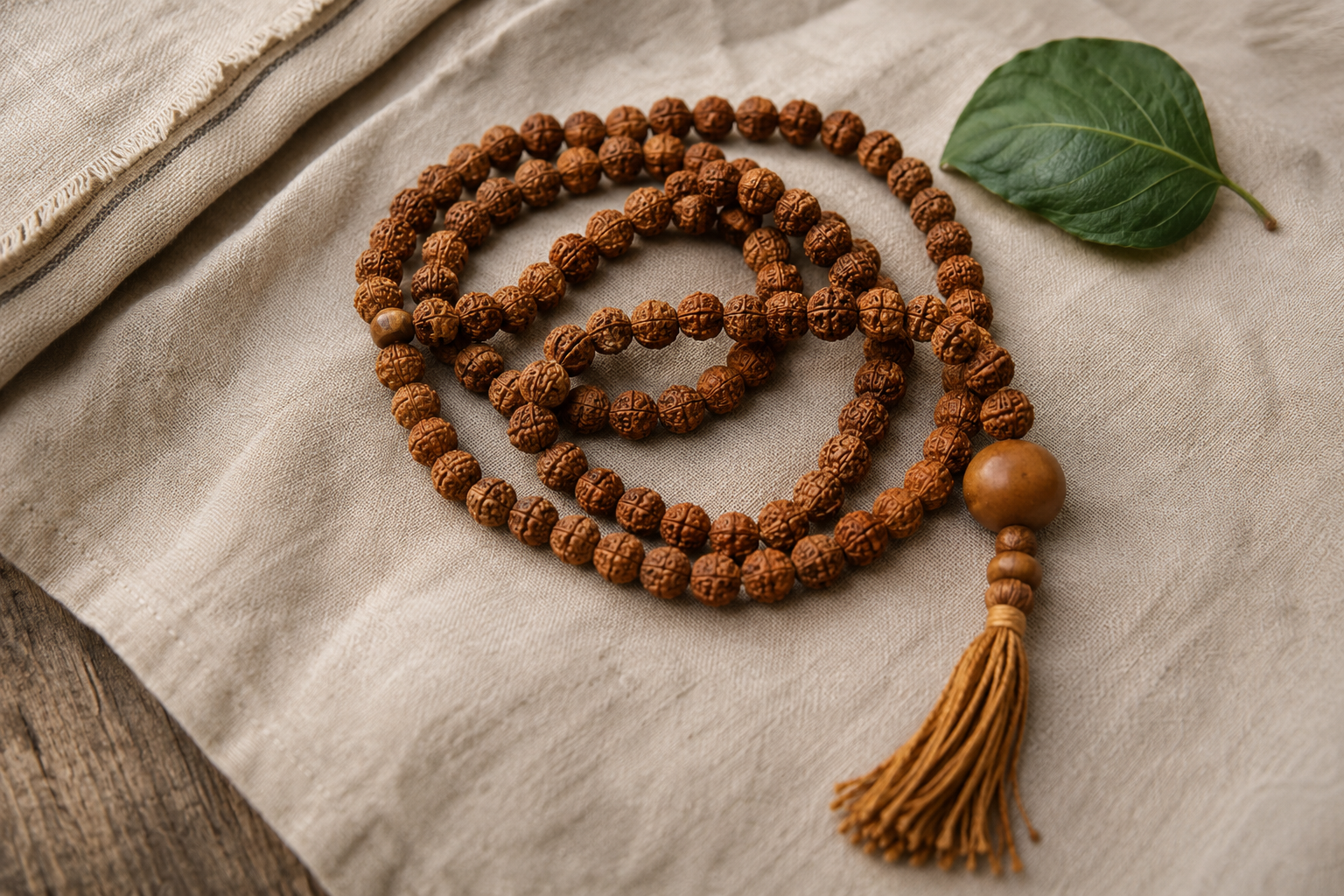
A traditional japa mālā commonly contains 108 counting beads and a distinct guru or meru bead. The sacred use of 108 reaches far beyond the modern custom of performing 108 Sun Salutations.
One of the most familiar ways of marking the solstice in contemporary yoga communities is the practice of 108 Sun Salutations.
The number 108 holds sacred and auspicious associations in several Dharmic traditions, including Hinduism, Buddhism, and Jainism. It appears in prayer, devotional recitation, sacred names, temples, textual classifications, ritual systems, and contemplative symbolism. A traditional japa mālā commonly contains 108 counting beads, in addition to a larger guru or meru bead.
There are many explanations for the significance of 108. Some are scriptural, cosmological, mathematical, astronomical, linguistic, ritual, or symbolic. These interpretations come from different traditions and periods, and they should not be blended together as though there were one universally accepted explanation.
Likewise, reverence for Sūrya—the sun—has deep roots in India. The sun is honored in Vedic hymns, ritual practice, devotional traditions, and daily observances. But ancient solar worship, the sacred use of 108, modern postural Sūrya Namaskāra, and the contemporary custom of performing 108 Sun Salutations at the solstice do not necessarily come from one uninterrupted historical practice.
Research into the history of Sūrya Namaskāra indicates that the dynamic sequence familiar to modern practitioners is largely associated with more recent forms of physical culture and modern yoga. It was not treated as an āsana sequence within the oldest yoga systems in the way it commonly is today.
This does not mean that 108 Sun Salutations are false, meaningless, or disrespectful. Traditions continue to develop, and new rituals can carry genuine spiritual depth.
A sequence of 108 salutations can become a moving mālā: each round a bead, each breath a prayer, each return an opportunity to release distraction and renew intention. It can embody discipline, devotion, remembrance, gratitude, and surrender.
But its meaning should not be assumed. Nor should completing all 108 become the measure of spiritual sincerity.
When the practice is framed as an endurance challenge, it can reinforce the very tendencies yoga asks us to observe: ego, comparison, attachment to achievement, disregard for the body, and the desire to prove ourselves.
A practice offered in the spirit of ahiṃsā must allow for modification, rest, stillness, chanting, meditation, and nonparticipation. A student who completes twelve mindful rounds may be more deeply engaged than someone who forces the body through 108 repetitions simply to say they finished.
The number should serve the practice. The practitioner should not be sacrificed to the number.
What Do We Mean by a “Yoga Mandala”?
The word maṇḍala is also used frequently in modern yoga classes, often to describe a sequence that turns to face different directions on the mat or moves in a circular pattern.
A circular or multidirectional sequence can be creative, intelligent, and deeply contemplative. Moving around the mat may help disrupt habitual orientation, cultivate concentration, and embody the cyclical movement of the seasons.
However, a traditional maṇḍala is not merely anything that moves in a circle.
In Hindu and Buddhist Tantric traditions, maṇḍalas can function as sacred diagrams used in ritual and meditation. They may represent the universe, a consecrated field, a divine realm, the structure of consciousness, or the dwelling and presence of a deity.
Calling a circular sequence a “mandala flow” is a modern adaptation. It can be offered respectfully, but ideally the teacher should understand the word, explain why it is being used, and avoid implying a traditional authority the sequence does not possess.
We can say, for example:
“This contemporary circular sequence is inspired by the symbolism of the maṇḍala as an ordered, sacred field. As we move through each direction, we will return repeatedly to the center.”
That brief explanation changes the quality of the offering. It transforms the term from decorative language into an invitation to learn.
The Problem Is Not Innovation—It Is Unconsciousness
Yoga has never remained completely static. Every teacher transmits through a particular language, body, culture, historical moment, and community. Adaptation is unavoidable.
The question is not whether yoga may evolve. The question is whether we are transparent about how it is evolving.
A modern practice does not need to claim ancient origins to have value. A creative sequence does not become more sacred because it is given a Sanskrit name. A seasonal ritual does not need an invented lineage to become meaningful.
Honesty is itself a yogic discipline.
We can distinguish among:
practices directly rooted in a particular text or lineage;
practices adapted from traditional forms;
modern conventions that have developed within global yoga culture;
and personal or creative offerings inspired by yogic principles.
These categories can overlap, but naming them helps students develop discernment. It also allows us to honor tradition without pretending that every familiar studio custom has existed since ancient times.
Before We Participate, We Can Learn to Ask
Respectful practice does not require perfect knowledge. No teacher or student understands every layer of yoga’s vast history. What matters is developing the humility to ask questions before repeating or teaching something.
Before leading or joining a special observance, we might ask:
Where does this practice come from?
Is it connected to a specific lineage, text, regional custom, devotional tradition, or modern teacher?
What does the terminology mean?
Am I using words such as mantra, maṇḍala, chakra, tantra, guru, or pūjā accurately, or only because they create a spiritual atmosphere?
Is this traditional, adapted, or newly created?
Can I communicate that distinction honestly?
Why are we using this number, symbol, sequence, or ritual?
What understanding is being offered alongside the action?
Does the form reflect the values it claims to honor?
Does an intense physical practice genuinely embody ahiṃsā? Does a celebration of unity include people with different bodies, abilities, ages, backgrounds, and financial resources?
Whose voices have informed my understanding?
Have I learned from Indian and South Asian teachers, scholars, practitioners, and texts, or only from sources that have already translated yoga through a Western commercial lens?
What happens after the event?
Will the celebration affect how we speak, consume, teach, serve, relate to nature, and respond to suffering—or will yoga end when the mats are rolled up?
These questions are not intended to create fear or prevent participation. They help transform participation into practice.
A More Complete Way to Observe the Day
A more faithful International Day of Yoga celebration does not need to reject āsana. It can place āsana back within the wider field of yoga.
A gathering might begin by acknowledging that yoga originated in India and has been preserved, developed, debated, and transmitted through generations of practitioners and teachers.
It might explain why the United Nations established the observance and why June 21 was selected.
It could introduce one ethical principle—perhaps ahiṃsā, satya, aparigraha, or svādhyāya—and invite participants to explore how that principle applies beyond the mat.
The physical practice could be offered as embodied inquiry rather than spectacle. Breath could be restored to a central role. Meditation, silence, study, appropriately contextualized mantra, or reflective journaling could be included.
A teacher offering 108 Sun Salutations could explain both the sacred significance of the number and the contemporary nature of combining it with a solstice postural ritual. Participants could be encouraged to complete a personally appropriate number of rounds, count breaths, repeat a mantra, sit in meditation, or dedicate each cycle to a person, place, or purpose.
A so-called mandala practice could include a genuine explanation of the maṇḍala as sacred order and invite participants to consider what it means to repeatedly return to the center.
The observance could also include seva—service—through environmental care, mutual aid, food collection, community support, or another action that extends practice beyond personal wellness.
Such a celebration would not be less accessible. It would be more complete.
Let the Solstice Be a Pause
The June solstice marks a moment when the sun appears to pause before changing direction. Perhaps International Day of Yoga can become a similar pause within global yoga culture.
It can be a moment to appreciate how widely yoga has traveled while also asking what may have been lost in that journey.
It can be a moment to celebrate the body without reducing yoga to the body.
It can be a moment to welcome innovation without inventing history.
It can be a moment to receive the gifts of another culture without erasing the people, languages, philosophies, and traditions through which those gifts were carried.
It can be a moment to replace performance with inquiry, consumption with relationship, and unconscious repetition with understanding.
The most important question on International Day of Yoga may not be:
How many Sun Salutations did I complete?
It may be:
What did I understand more deeply because I practiced?
Did the practice make me more attentive?
More truthful?
More compassionate?
More aware of what I consume and appropriate?
More respectful of the traditions from which I learn?
More willing to recognize the dignity and interconnection of life?
If yoga is a movement toward integration, then understanding cannot remain separate from participation. Respect cannot remain separate from celebration. What we do with the body cannot remain separate from how we live.
Before we repeat the ritual, use the sacred word, perform the sequence, or share the photograph, we can pause.
We can learn where the practice came from.
We can ask what it means.
We can acknowledge what we do not yet know.
And then, with greater humility, gratitude, and awareness, we can participate.
That pause may be one of the most honest ways to honor both the solstice and yoga.